DOLPHIN FIBERNetwork equipment for Africa Send a project enquiry
Fiber network equipment / Technical library Optical reference library

Investing in and constructing data center server racks

Jump to a section
Source context

AI source overview

Investing in and constructing data center server racks requires careful consideration of rack type, dimensions, weight capacity, cooling, power distribution, and scalability to ensure operational efficiency and long-term ROI.

Understanding Server Rack Types

Server racks are standardized enclosures designed to house IT equipment such as servers, switches, storage arrays, and power distribution units. The main types include: Open-frame racks: Lightweight, cost-effective, and ideal for cable-intensive or non-secure environments. They provide excellent airflow but limited physical security.

Enclosed cabinets: The standard choice for modern data centers, offering doors, side panels, and integrated cooling options. They provide enhanced security and support high-density deployments. Wall-mount racks: Suitable for smaller installations or branch offices, offering compact solutions for limited space.

Key Design Considerations

When constructing or investing in racks, consider the following: Dimensions and Rack Units (U): Standard width is 19 inches, with height measured in rack units (1U = 1. 75 inches). Depth varies from 600–1200 mm depending on equipment.

Weight Capacity: Racks must support the static and dynamic load of fully populated equipment. High-performance racks can hold over 1,000 kg. Cooling and Airflow: Proper airflow management, including hot/cold aisle containment and fan integration, is critical to prevent overheating and maintain energy efficiency.

Power Distribution: Integration of PDUs, UPS systems, and dual power feeds ensures redundancy and uninterrupted operation. Cable Management: Vertical and horizontal organizers, labeling, and structured routing reduce clutter, improve airflow, and simplify maintenance. Security: Lockable doors, side panels, and environmental monitoring protect sensitive equipment.

Investment and Market Insights

The global server rack market is projected to reach $5. 2 billion by 2028, driven by cloud computing, edge computing, and AI infrastructure demands. Investing in high-quality racks can reduce operational costs, improve uptime, and support future scalability.

Preconfigured racks offer faster deployment and lower initial costs, while customized racks provide tailored solutions for unique environmental or operational requirements.

Best Practices for Construction and Deployment

Plan for Scalability: Design racks to accommodate future growth in equipment density and power requirements. Integrate with DCIM Tools: Use data center infrastructure management software to monitor rack performance, power usage, and thermal conditions. Regular Maintenance: Ensure grounding, inspect airflow, and audit cable management to maintain efficiency and prevent failures.

Optimize Layout: Align racks in hot/cold aisle configurations and consider overhead or underfloor cabling for optimal airflow and accessibility. Investing in and constructing server racks with these considerations ensures a robust, efficient, and scalable data center infrastructure, capable of supporting high-density computing and evolving IT demands.

Research context

Reference summary

Data Center Server Rack: The Ultimate Guide [2026]How to size, lay out, and cool data center server racks the right way. A practical guide to rack units, p.

From reference to enquiry

Questions for your project

Use these editorial prompts alongside the linked excerpts. They identify items to confirm for your project.

Detailed reading / connection to installation

Fiber infrastructure reference
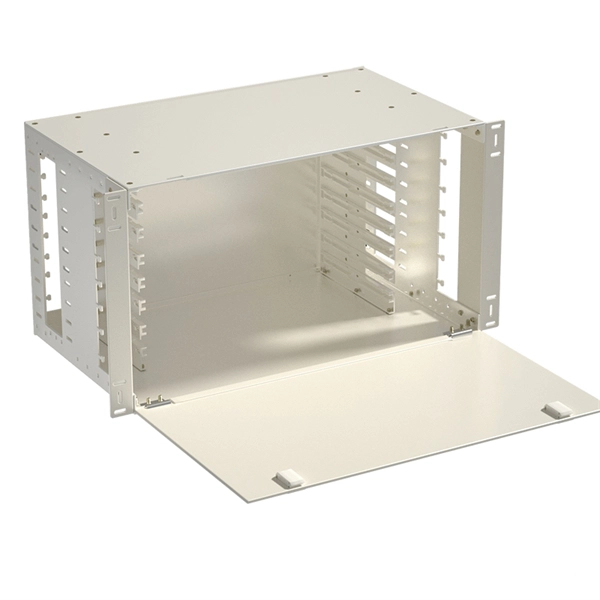
Investing in and constructing data center server racks
Equipment illustration / verify against the selected product
Data Center Server Rack: The Ultimate Guide

How to size, lay out, and cool data center server racks the right way. A practical guide to rack units, power density, and airflow for 2026 builds.

Data Center Server Rack Guide (2026): Types, Design,

This guide provides a deep engineering overview of rack architecture, cooling integration, power redundancy, cable routing, and real-world

What is a Data Center Rack? The Complete Guide to Server Racks

By choosing the right rack type, following best practices for setup and cooling, and planning for scalability, organizations can ensure optimal performance and reliability.

Data center construction guide: Costs, timelines, and equipment

Review the costs, timelines, and essential equipment in this data center construction guide. Plus, see the best way to speed up construction and optimize your build.

Why invest in the data center economy | McKinsey

Savvy private investors has been snapping up data centers in recent years. We explore why more companies should invest in the growing data center

The Complete Guide to Server Racks: Functions, Standards, and Data

Server racks are more than IT equipment “containers”—they are the backbone of high-density, reliable, and sustainable data centers. By combining standardized design with intelligent

The Complete Guide to Data Center Construction:

Explore the data center construction process. Learn about timelines, challenges, best practices, and how to build efficient data centers.

Data Center Design and Construction: A Complete Guide

Learn how to design and build a data center with this 8-step guide. Explore key components, best practices & requirements for a secure, scalable facility.

Data Center Construction: Costs, Timeline, and Delivery Steps

Data center construction builds secure facilities for servers, power, and cooling systems. Get costs, timelines, key steps, and tips to manage your project.

A Guide to Data Center Construction

Data center construction is in high demand with AI and data advances. Find out everything you need to know in our comprehensive guide.

Inside the relentless race for AI capacity

This is the first article in a three-part series exploring the relentless race for AI capacity and the data centres at the heart of hundreds of billions of dollars in capital investment.

Data Center Rack Power Costs: A Condensed Analysis

Understanding Data Center Rack Power Consumption Data center power density, measured in kilowatts (kW) per server rack, is crucial for

AI Data Center Power: 415 TWh in 2024, 945 TWh by 2030

Global data centers consumed 415 TWh in 2024 and will reach 945 TWh by 2030. AI rack power density, PUE explained, and what the energy surge means.

Data Center Tiers Explained: Tier I, II, III & IV (2026 Guide

Learn the differences between data center tiers, from Tier I to Tier IV. Covers uptime, cost, certification, and how to choose the right tier for your needs.

Compute Forecast | Insights on AI, Data Centers

Stay ahead of the compute economy with Compute Forecast- delivering research, news, and strategic analysis on AI, data centers, cloud, and

AI Data Center Value Chain: Every Layer from Chips to Cloud

AI data center value chain: chips to cloud. Semiconductor, GPU design, servers, networking, power, and cloud layers mapped by company. Interactive.

Investing in jobs, infrastructure and schools: Meta data

Data centers partner with schools, communities Meta is committed to playing a positive role and investing in the long-term vitality of our data center

The cost of compute power: A $7 trillion race | McKinsey

In data centers across the globe, millions of servers run 24/7 to process the foundation models and machine learning applications that underpin

Related Video Reference

This video was associated with the source search result. Verify technical details against current product documentation and project requirements.

Specify your fiber equipment

Share the fiber interfaces, termination capacity, cable route and evidence required for handover.

Send a project brief